

The way results appear on Google searches have been changed significantly. Google now provides AI-generated summaries to compile information to deliver clear and direct answers to the users improving satisfaction and efficiency. This major shift has redefined how visibility and credibility can be built online, simultaneously. Every business has recently noticed the impact with rising zero-click movement even on their top performing pages leading to reduced conversions and decline in ROI. Simultaneously, some websites have seen an opposite effect with growing organic traffic after being mentioned by Google AI Overviews. This has left the website owners wondering whether this selection process is random or there is a requirement to refine their strategy focused on relevance, reliability, and technical precision. Let’s answer this by learning what Google’s AI Overviews are, how they work, and how to position your website as a credible source for Google AI Overview.
What are Google AI Overviews
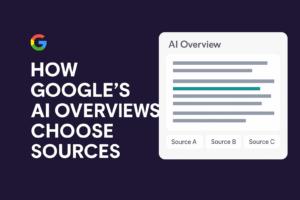
Google AI overviews are the AI generated summaries to answer user queries. They appear at the top of the search results, mostly, before sponsored pages. This AI understands the question of the user and prepares a relevant answer to it using various ranking pages on Google. Also, this summary includes clickable links from where reference is taken by AI. Not only this, but Google AI overviews can also solve complex, multifaceted questions, aid in preparing itineraries with changes required without searching again, and provide in detail analysis as well.
How AI Summaries Impact Online Visibility
Due to the rise of Google AI overviews, many businesses are witnessing a sharp decline in their organic traffic leading to zero clicks generation, lesser visibility, and different winners who cater intent precisely. The reason being the AI model provides direct answers without leaving Google. With every question answered, users are less likely to follow any link despite strong brand awareness and significant topical authority.
What Experts Found Out While Researching on AI Overview Sources
1. Google AI Overviews Have Two Types of Sources to Refer
There are two types of sources:
- Core Sources: these are the frequently used URLs that appear in multiple resources for same queries.
- Non-Core Sources: these don’t appear in searches often.
The fact is that some sources are more stable than others, these are known as core sources.
2. Authority & Semantics Matter
It is unlikely for Google to refer to the pages with lower domain authority. When it comes to domain score, internal authority matters significantly. This also is a factor in division between core and non-core sources. However, authority solely isn’t the reason behind this bifurcation. Moreover, the core sources include strongly aligned pages with the queries. Having matching or similar titles and slugs make it feel more relevant for Google.
3. 50+ Positions are Significant
In Google AI Overviews, on an average up to 8 sources are used per response. Only 2.7% AIOs visit up to 27 sources. Therefore, ranking higher in SERPs increases your chances to be used as a source. Moreover, if you are in the top 50, there is a minimal chance that you will show up or get visited by generative AI. The reason being, Google also visits related query pages for a comprehensive answer.
4. Core Sources > Non-core Sources
Many reports confirm that the “old school” SEO remains an important part of AI summaries leading to core sources outperforming non core ones.
5. Google AI Overviews Skip Sources
This is a rare situation but google AI overviews have 1% cases where they skip sources directly and use built-in information for their answers. Especially for common knowledge queries such as “what is water/fire.” As said by Google’s Mark Williams-Cook, user queries are generally classified into 8 categories, that you need to follow as well:
- Short facts
- Comparison
- Reason
- Definition
- Instruction
- Bool
- Consequence
- Others
Keeping these in mind, let’s learn how to optimize your website for Google AI Overview.
How to Become a Source For Google AI Overviews
Appearing in Google AI Overviews needs a strong strategy formulation. To become a source for Google AI Overviews, positioning content properly, reliably, and expertly matters the most. Whether you are a blogger, website owner, or an SEO expert, follow these tips to make your webpage/blog “AI-overview friendly” and increase your citation as well as organic visibility.
Content Quality Matters
High-quality content builds trustworthiness and Google boosts content crafted according to the EEAT guidelines. Write authoritative content, provide value with experience, and build credibility with actionable tips and expertise. Research thoroughly to ensure factual accuracy. Provide unique insights wherever possible. Include infographics to make content easy for humans to skim through.
Moreover, work on topical authority building by identifying and covering topics comprehensively. Focus on all related keywords and cover it in-depth. Understand what users are looking for and clearly cover all aspects related to those keywords. Incorporate FAQs and diversify content formats using videos, podcasts, and interactive tools like calculators, surveys, etc. Steps to build topical authority:
- Look for what people ask in “People Also Ask” sections and related searches.
- Check the keyword panel in Google search bar.
- Use extensions like “What’s my Serp” for finding search volume.
- Organize content in clusters by grouping related pages together.
- Start with one comprehensive pillar page and link all subtopics to this pillar page.
Two approaches you can for use for topical content:
| Approach 1: Pillar First | Approach 2: Cluster First |
| Start with a broader topic. For example, How to Build a MVP Follow with cluster topics such as Cost of MVP Development, MVP Tech Stack, How to Make MVP Scalable, etc. | Start with cluster topics such as Cost of MVP Development, MVP Tech Stack, How to Make MVP Scalable, etc. Follow with a broader topic. For example, How to Build a MVP |
Avoid cannibalization by using different and unique angles in each topic and avoid overlapping content. Link every cluster page to pillar page and cluster pages wherever possible. Google’s AI Overview pulls deep knowledge based pages.
Match User Intent
The objective of AI overviews is to provide quick responses to users. The intention is to satisfy them without making them leave Google. Improve chances of getting selected by providing direct, clear, and concise answers to the user queries. Use the same questions and long tail words as it is. Search your keyword on Google before writing, see what structure is followed and try to incorporate your content in a similar structure. For example, if on searching one keyword, maximum responses are in guide format, embrace that format only.
Use Simple Language & Format Content Properly
While answering user queries, opt for simple and plain language. Keep it natural and explain technical jargons if used. Also, avoid adding slangs that are not famous, complex or confuse AI as well as the audience. Write for humans as well, not only for Generative AI. Use tools like Hemingway Editor to understand how simple and impactful your content is. Furthermore, a proper format makes content more skimmable with adequate headings, short paragraphs, and lists as well as bullet points. Most Google AI Overview summaries include lists in their responses.
Improve Ranking in Search Results
As we know, appearing in top 10 searches is essential for becoming a source for Google AI Overviews. Start with on-page optimization for appearing in top results. As AI derives content with finding exact or similar keywords, using adequate density for the keywords and performing an analysis using YoastSEO like tools helps in getting spotted early. Add relevant internal links and earn high quality backlinks for building authority boosting your SERP rank.
Use Structured Data
Schema markup plays an important role in telling Google AI what your content is about. There are various types of schema markup such as product, person, etc., use as much as you can to help Google find you. Google Search Console makes it easier to see what your website is reflecting.
Google’s Technical Requirements Matter
To become a source for Google AI Overviews, your content needs to be accessed and indexed. Make sure your website’s technical aspects are on point. Check if Google’s crawler can visit your page smoothly. Serve your page with HTTP 200 status code, and see if your pages contain indexable file types.
In The End
This is a turning point for SEO experts with Google AI Overviews using more factors than keywords to extract information and compile a wholly worth it answer. In such a scenario, optimizing accordingly is essential. Generative AI prioritizes clear, concise, and intent-based content. Also, the major ranking influencing factors include structuring, formatting, and helping Google understand your content clearly. Refine your SEO strategy and refocus it to appear in the AI summaries to achieve the required business goals.